




In the summer of 2012, a young American, Alexander Scott English (英亚东), arrived at Zhejiang University's Xixi Campus with a backpack. Little did he know that this decision would become far more than a language-learning experience—it would mark the beginning of an academic journey and a journey of cultural belonging that would intertwine his life with China for more than a decade.
A Decision That Changed Everything
The idea first emerged after he completed his undergraduate studies. Curious about the world's most challenging language, he searched online and found a recurring answer: Chinese. What began as a simple question soon became a life-changing decision.
During a visit around the time of the 2008 Beijing Olympic Games, he travelled to several Chinese cities. Among them, Hangzhou left the deepest impression. "Hangzhou is beautiful. Life moves at a comfortable pace, and it is a great place for study and reflection," he recalled. Drawn by the city's tea culture, mountains, and lakes, he chose to pursue his doctoral studies in Applied Psychology at Zhejiang University in 2012.
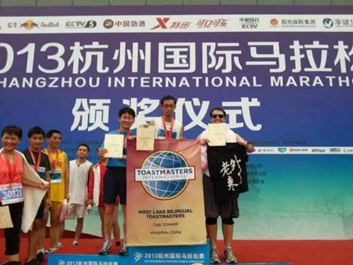
(Alexander English participates in the Hangzhou International Marathon)
From Cultural Observer to CulturalParticipant
When Alexander first arrived at ZJU, he lived in the student dormitory on Xixi Campus. "Each floor was home to students from different countries and academic disciplines. It felt like a small global village," he said. "It was a place where people could share and learn about one another's cultures."
During his doctoral studies at Zhejiang University, he worked closely with Prof. MA Jianhong, participating in international academic exchanges and research activities in Indonesia, Thailand, Germany, and other countries. These experiences broadened his academic horizons while demonstrating the value of intercultural dialogue.
In 2014, he participated in the inaugural China–US Young Leaders Symposium, where student representatives from leading universities in both countries engaged in discussions and jointly issued the “Shanghai Consensus of the China–US Young Leaders Symposium”.
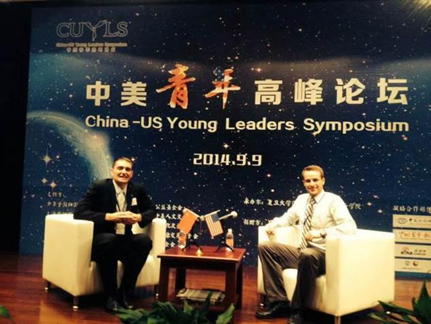
(Alexander English participates in the inaugural China–US Young Leaders Symposium)
Yet Alexander was determined not to remain within the comfort zone often associated with international student life. "If I was going to live in China, I wanted to truly become part of the local culture," he said. He encouraged his advisor to communicate with him entirely in Chinese. "Professor MA cared deeply about his students. He created a fully Chinese-speaking environment for me and supported me in many aspects of daily life. Every spring, when my pollen allergies flared up, he would even bring me medicine." The kindness and mentorship he received helped transform China from a place of study into a place of belonging.
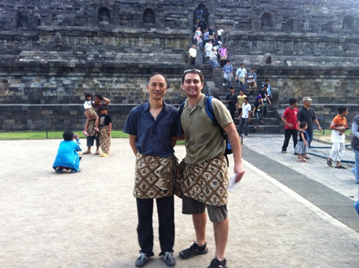
(Alexander English with Prof. Ma Jianhong)
Research Grounded in Real-World Experience
During his doctoral studies at Zhejiang University, Alexander focused on cross-cultural adaptation, a field closely connected to his own experiences. "I come from the United States and work in China. I naturally view the world through a cross-cultural lens," he explained.
After graduation, he expanded his research to examine adaptation among China's internal migrant populations. In 2019, he delivered a TED talk titled "How Rice and Wheat Shape Cultural Differences in China," drawing on Rice Theory to explore cultural differences between northern and southern China and the adaptation challenges associated with large-scale population mobility across regions and between rural and urban areas. "Cultural adaptation is not only an issue for foreigners," he noted. "In a country with significant population movement, anyone who leaves home must undergo a process of psychological reconstruction."
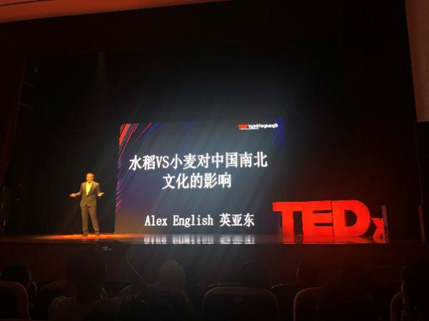
(Alexander English delivers a TED talk)
This year, his research project, Learning from Others: The Impact of Foreign Talent Identification and Adaptation on Creativity in Cross-Cultural Teams, received a grant from the National Natural Science Foundation of China (NSFC), marking another milestone in his academic career.
Over the years, Alexander's role has evolved from studying how foreigners adapt to China to exploring how China can better attract, integrate, and retain global talent. In many ways, he has become a bridge-builder connecting cultures through research and dialogue. Reflecting on his future plans, he remains committed to exploring the depth and diversity of Chinese culture while ensuring that his research remains closely connected to real-world challenges.
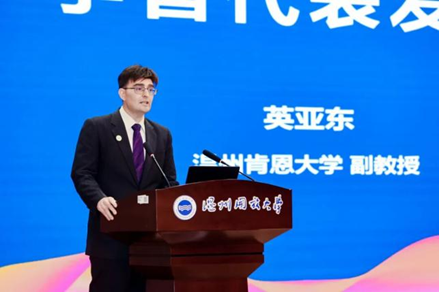
(Alexander English speaks as a representative of Oujiang Young Scholars)
Finding a Home in China
Today, Alexander speaks fluent Chinese and has travelled to 28 provinces across China. From climbing Mount Tai to hiking Mount Heng, he has explored the country not only through books and research but also through personal experience. What began as a fascination with one of the world's most challenging languages ultimately became a search for belonging. From ZJU, he embarked on a path that led him to become an international scholar of cross-cultural psychology. Looking ahead, he hopes to continue advancing research and innovation in the field while building greater understanding between China and the rest of the world.
Alumni Profile
Alexander Scott English (英亚东) earned his Ph.D. in Applied Psychology from Zhejiang University in 2016. He is currently an Associate Professor in the Department of Psychology at the College of Humanities, Wenzhou-Kean University, and an Associate Editor of the SSCI-indexed journal International Journal of Intercultural Relations.
His research focuses on cross-cultural psychology, particularly adaptation mechanisms for sojourners and Chinese patterns of thinking. He is a member of the International Association for Cross-Cultural Psychology (IACCP), the Asian Association of Social Psychology (AASP), the International Academy for Intercultural Research (IAIR), and the Chinese Society of Cultural Psychology, and is the recipient of the Asian Association of Social Psychology Early Career Achievement Award.


@ Study at ZJU Wechat Subscription
Copyright © 2021International college,
Zhejiang University
Technical Support : hzccx Manage Login
You are the 1000 visitor


