




Recently, the 19th session of the Academic Lecture Series of the International College at Zhejiang University (ZJU) was held in Room 112 of the International College Building. Professor Sun Chaofen from Stanford University was invited to deliver a lecture entitled Why Do We Not Say “Wish You a Very Happy Birthday” in Chinese—Gradability of Adjectives and Degree Adverbs. The lecture was chaired by Vice Dean Chen Weiying and attended by faculty members and students from the International College and the Center for Language and Cognition.
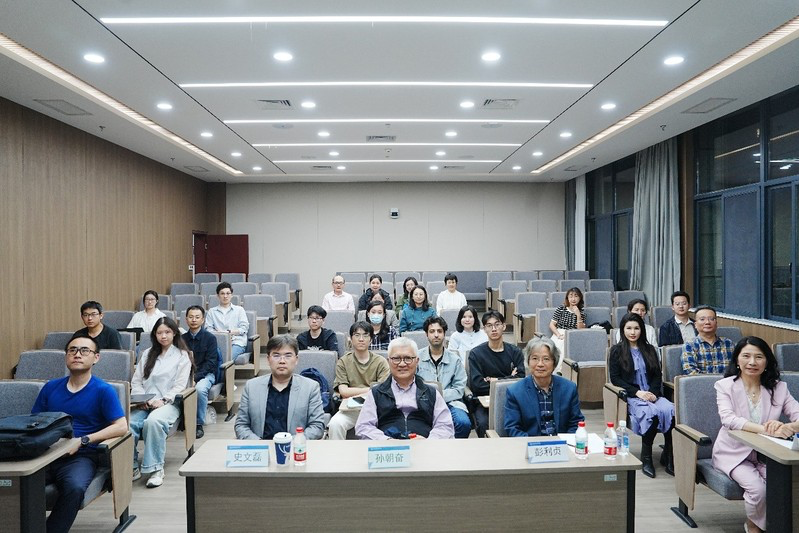
At the beginning of the lecture, Professor Sun introduced a simple yet significant question using the everyday expression “Wish you a happy birthday”: Why is Zhu ni shengri kuaile (“Wish you a happy birthday”) acceptable in Chinese, while Zhu ni shengri hen kuaile (“Wish you a very happy birthday”) sounds unnatural? Building on this question, he explained the semantic features of Chinese adjectives, the grammatical functions of degree adverbs, and the fundamental differences between the adjective systems of Chinese and English.
Professor Sun pointed out that English adjectives exhibit morphological distinctions such as the positive, comparative, and superlative forms (e.g., tall / taller / tallest), whereas Chinese adjectives remain unchanged in comparative constructions. For example, the adjective gao (“tall”) remains the same form in expressions such as Ta gao (“He is tall”), Ta bi wo gao (“He is taller than me”), and Ta bi wo geng gao (“He is taller than me”). Comparative meaning in Chinese is conveyed primarily through syntax and context rather than morphological changes to the adjective itself. He emphasized that overlooking this typological distinction often leads to incomplete interpretations of Chinese adjectives and degree adverbs. To understand Chinese adjectives, one cannot simply apply grammatical frameworks developed for English or other European languages, but must instead examine the structural and semantic characteristics of Chinese itself.
Focusing on the concepts of gradable (degree-bearing) and non-gradable (degree-neutral) adjectives, Professor Sun further analyzed how Chinese adjectives interact with degree adverbs. He explained that not all Chinese adjectives can be modified in the same way. While adjectives such as gao (“tall”), hao (“good”), and kuaile (“happy”) naturally combine with degree markers like hen (“very”), feichang (“extremely”), and zui (“most”), non-gradable adjectives such as sili (“private”) and jinkou (“imported”) cannot be directly modified by these degree adverbs or function independently as predicates. Instead, they typically require constructions such as shi...de. Professor Sun also stressed that hen is far more than the Chinese equivalent of the English word very. In many contexts, it functions as an affirmative degree marker, enabling adjective phrases to serve naturally as predicates while conveying an appropriate degree interpretation. For instance, the question Zheyang hao bu hao? (“Is this okay?”) can simply be answered with Hao (“Okay”), and Ta gao bu gao? (“Is she tall?”) can be answered with Gao (“Tall”). These examples demonstrate the close relationship between predication, affirmation, and degree expression in Chinese adjectives.
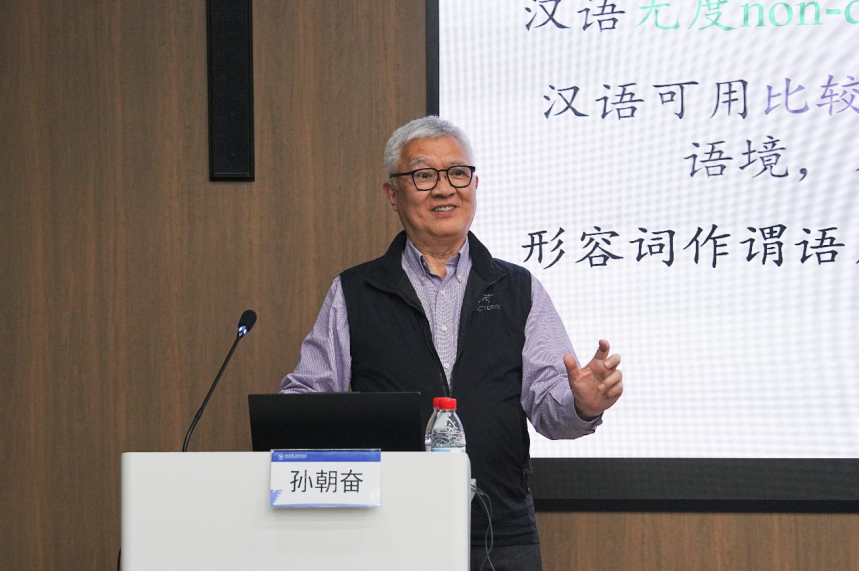
Moving on to comparative constructions, Professor Sun further categorized them into explicit vs. implicit comparison, and direct vs. indirect comparison. Drawing on examples including Ta bi wo gao (“He is taller than me”), Ta bi wo geng hao (“He is better than me”), Yao Ming gao (Y”ao Ming is tall”) and Yao Ming gezi gao (Y”ao Ming is tall in stature”), he explained that direct comparative sentences contain an explicit standard of comparison, whereas indirect comparison relies entirely on contextual cues for validity.
He noted that adverbs such as geng (“more”) and hai (“even”) do not carry fixed absolute scalar values; instead, they signal further comparison within a given context. This accounts for the ungrammaticality of *Ta bi wo hen hao versus the acceptable Ta bi wo geng hao (“He is better than me”), and proves Chinese lacks morphological comparative forms analogous to English.
Professor Sun also discussed the scalar values of degree adverbs, patterns of negation, exclamatory constructions, and comparison in everyday language. Through examples such as Meiyou zuihao, zhiyou genghao (“There is no best, only better”), Meiyou feichang hao (“not extremely good”), and Bu tai hao (“not very good”), he illustrated the different functions of bu and meiyou in negating adjectival predicates. Exclamatory expressions such as Hao! Hao! Hao! (“Good! Good! Good!”), Gao! Shizai shi gao! (“Tall! Truly tall!”), and La meizi, la meizi, la! la! la! (“Spicy girls, spicy girls, spicy! spicy! spicy!”) further demonstrated how bare adjectives in Chinese can independently express emphasis, exclamation, and intensified meaning.
Balancing rigorous theoretical depth with authentic language data, the lecture laid bare the linguistic rules underpinning everyday Chinese expressions. Towards the end, Professor Sun circled back to the lecture’s core question. He argued that words like hao (“good”) and kuaile (“happy”) in Chinese blessings carry open-ended, unbounded positive semantics, rendering phrases such as Zhu hao (“Best wishes”) and Zhu ni shengri kuaile (“Wish you a happy birthday”) natural and idiomatic. By contrast, Zhu hen hao and Zhu ni shengri hen kuaile sound awkward because their degree markers conflict with the unbounded semantic requirement of blessing formulas. He concluded that only by grasping the scalar properties of Chinese adjectives and the grammatical roles of degree markers can Chinese language instructors concisely and accurately explain such easily misused grammatical phenomena to international learners.
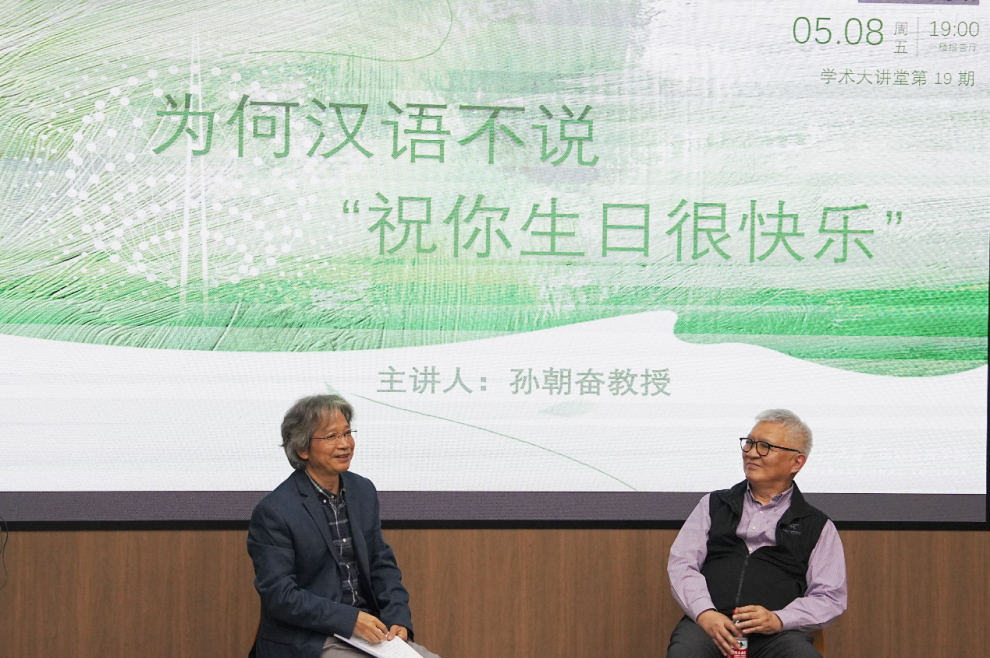
Following the lecture, Professor Peng Lizhen from Zhejiang University served as the discussant. He engaged Professor Sun in an in-depth discussion on topics including the origin of the research, adjective negation, whether gradability should be regarded as a semantic or pragmatic phenomenon, and the explanatory power of the concepts of realis and irrealis in the study of Chinese adjectives. Drawing on Chinese linguistic data and typological perspectives, Professor Sun responded to each question in detail, further illustrating the complex relationships among adjective semantics, degree expression, and contextual interpretation.
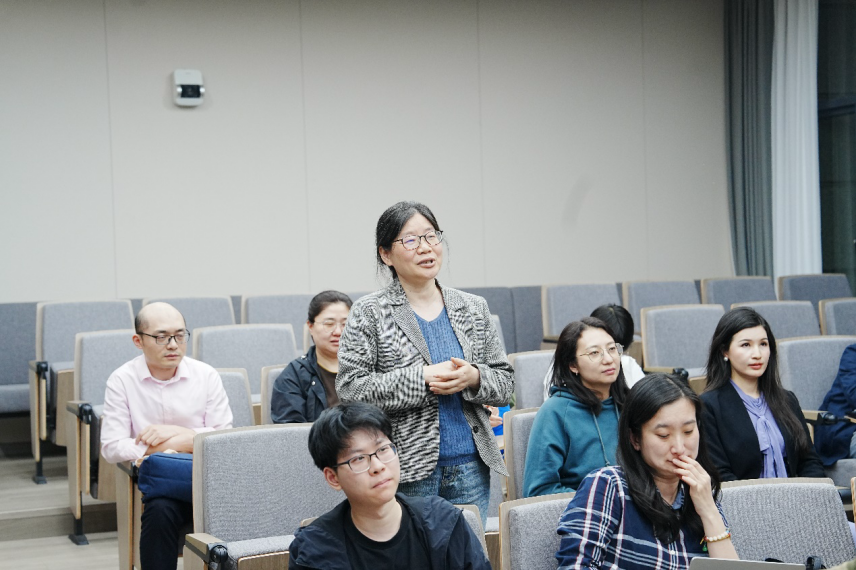
During the Q&A session, faculty members and students actively participated in the discussion. Associate Professor Hu Xiaohui, Deputy Director of the Teaching Center at the International College, raised a common question encountered in teaching international Chinese: when should learners use hao (“good”) and when should they use hen hao (“very good”)? Dr. Shen Yu from the Teaching Center asked how context influences the interpretation of gradability in Chinese adjectives, prompting further discussion on the mechanisms through which adjectival meanings are constructed. A graduate student specializing in linguistics also asked about the subjective and objective standards underlying comparative constructions. Professor Sun provided thoughtful responses to each question and emphasized that effective teaching of Chinese adjectives requires not only an accurate understanding of linguistic facts but also the ability to translate complex linguistic theories into explanations that are accessible to language learners.
Using everyday Chinese expressions as its starting point, the lecture offered an in-depth exploration of the semantic mechanisms underlying Chinese adjectives, degree adverbs, and comparative constructions. It demonstrated the explanatory power of contemporary linguistic theory in the study of Chinese while providing fresh perspectives for grammar instruction in international Chinese language education. Combining academic rigor with an accessible presentation, the lecture enabled faculty members and students to gain a deeper understanding of the Chinese adjective system and the expression of degree.
Professor Sun Chaofen has long specialized in Chinese linguistics, the history of the Chinese language, grammaticalization, and the teaching of Chinese as a second language. He received his Ph.D. from Cornell University in 1988. Since 1991, he has directed the Chinese language program at Stanford University and has served as Chair of the Department of East Asian Languages and Cultures and Director of the Center for East Asian Studies. He has also served as President of both the Chinese Language Teachers Association of California and the Chinese Language Teachers Association of the United States. His research has appeared in leading journals including Language, Journal of Chinese Linguistics, and Journal of the American Oriental Society. His publications include Word Order Change and Grammaticalization in the History of Chinese and Chinese: A Linguistic Introduction, and he has co-edited volumes such as The Oxford Handbook of Chinese Linguistics and Key Issues in Chinese as a Second Language Research.
Text:WU Jian
Photos:ICSNMC


@ Study at ZJU Wechat Subscription
Copyright © 2021International college,
Zhejiang University
Technical Support : hzccx Manage Login
You are the 1000 visitor


