




Recently, in response to the new opportunities and challenges facing International Chinese Language Education in the new era and to support front-line teachers in upgrade their Chinese teaching capabilities, the teaching team from the International College of Zhejiang University was invited by Foreign Language Teaching and Research Press (FLTRP) to deliver the 2026 “Virtual Teaching and Research Community” online lecture series. The programme attracted more than 20,000 participants from China and abroad, providing a collaborative platform for high-level teaching and research exchanges.
The first session focused on the widely adopted New HSK Standard Course series. Distinguished members of the textbook development team and leading scholars in International Chinese Language Education were invited to discuss key topics, including the direction of the HSK 3.0 reform, the principles and design of the new textbooks, classroom teaching design and demonstration, and the integration of artificial intelligence into language teaching. Participants explored how emerging digital technologies could be effectively incorporated throughout the teaching process to create new pathways for International Chinese Language Education in the era of digital intelligence.
During the event, Wu Jian, Assistant Researcher and Head of the Teaching and Research Group at the International College of Zhejiang University, delivered a keynote presentation entitled “GenAI-Empowered International Chinese Classrooms: Teaching and Assessment Innovation Driven by New Technologies.” He introduced the intelligent transformation of the New HSK Standard Course through the FLTRP International Smart Education Platform. According to Wu, the textbook series has established a comprehensive digital learning portal featuring Xiaoyu, an AI teaching assistant that seamlessly connects printed textbooks with digital resources, helping learners consolidate and expand learning outcomes. The platform integrates abundant multimodal learning resources into a complete “Learn–Practice–Test–Evaluate” learning cycle, providing comprehensive support for both classroom teaching and independent learning. It has also been designed with both global and local teaching needs in mind, allowing flexible adaptation and implementation in different educational contexts around the world.
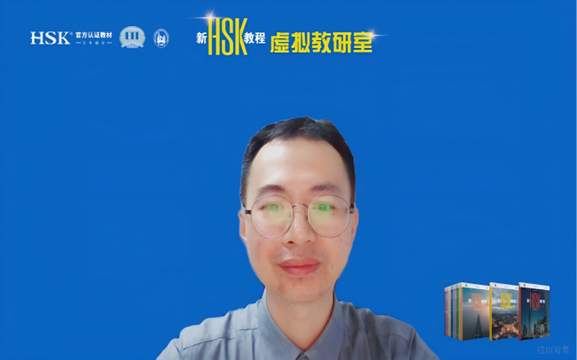
Regarding the practical application of AI in language teaching, Wu highlighted two innovative examples. The first was listen-and-repeat (Elicited Imitation Test, EIT) training powered by speech foundation models, which significantly improves learners' pronunciation perception and production. The second was an intelligent writing feedback system supported by deep reasoning models, providing personalized and AI-assisted writing guidance for students. He emphasized that while Generative Artificial Intelligence (GenAI) demonstrates tremendous practical value in language learning, technology should always remain an instructional aid rather than a substitute for teachers. In the AI era, educational innovation depends on effective collaboration between educators and technology, while teachers continue to retain ultimate responsibility for instructional design, classroom implementation, assessment, and academic judgment.
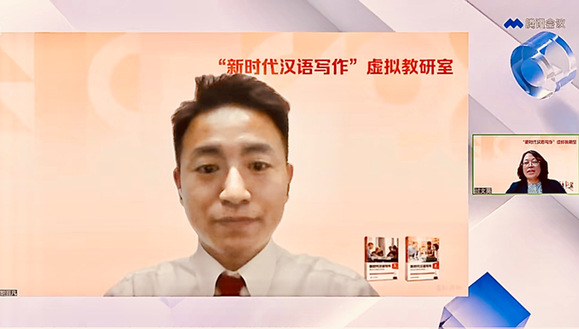
The second lecture featured Hu Yufan, a young faculty member from the International College, who presented “Design and Practice of Intermediate Chinese Reading and Writing Instruction: A Case Study of New Era Chinese Writing 1—'City Impressions'.” Hu demonstrated an integrated reading-and-writing teaching model designed for intermediate and advanced learners. The session was moderated and reviewed online by Guo Wenying, Deputy Director of the Teaching Center at the International College and a member of the chief editorial team for the New Era Chinese Writing textbook series.
Using three model essays, including “Shanghai's Old Streets”, the teaching case established a classroom model consisting of reading and writing input, guided practice and internalization, and writing output, while incorporating extension activities such as urban field studies. The lesson focused on identifying distinctive urban characteristics, constructing narrative essay structures, and applying multi-perspective descriptive techniques. Innovative teaching approaches—including flipped classrooms, collaborative group brainstorming, and a four-dimensional assessment framework—were integrated to guide learners in completing city description writing tasks while deepening their understanding of contemporary China and the cultural diversity of cities around the world, thereby promoting mutual learning between Chinese and global civilizations.
Participants praised the lecture series, noting that the online Virtual Teaching and Research Community combined cutting-edge theory with practical applications. They remarked that the sessions offered valuable and applicable teaching strategies for front-line educators. Looking ahead, the International College of Zhejiang University will continue collaborating with FLTRP and other educational publishing and research platforms to organize more academic events. The college will keep empowering international Chinese language teachers’ professional growth and fuel the high-quality development of this discipline.
Text: Hu Yufan


@ Study at ZJU Wechat Subscription
Copyright © 2021International college,
Zhejiang University
Technical Support : hzccx Manage Login
You are the 1000 visitor


