




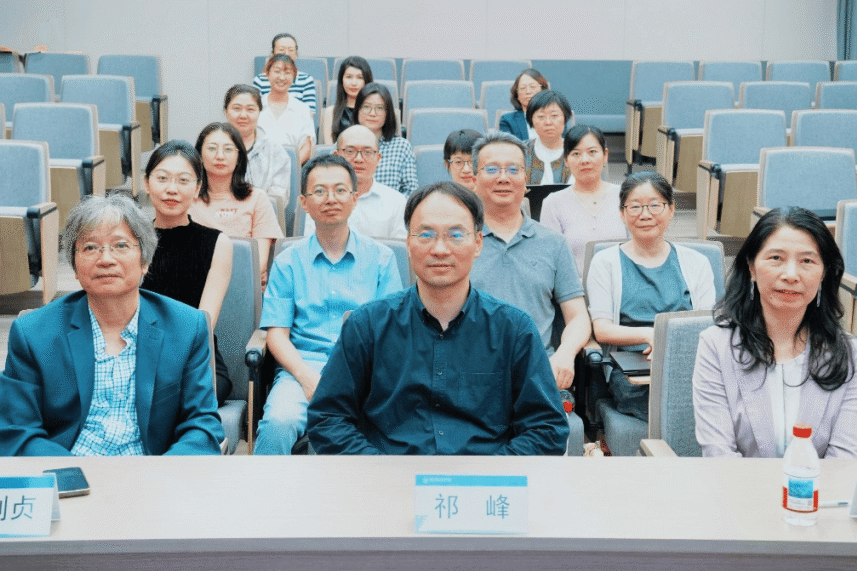
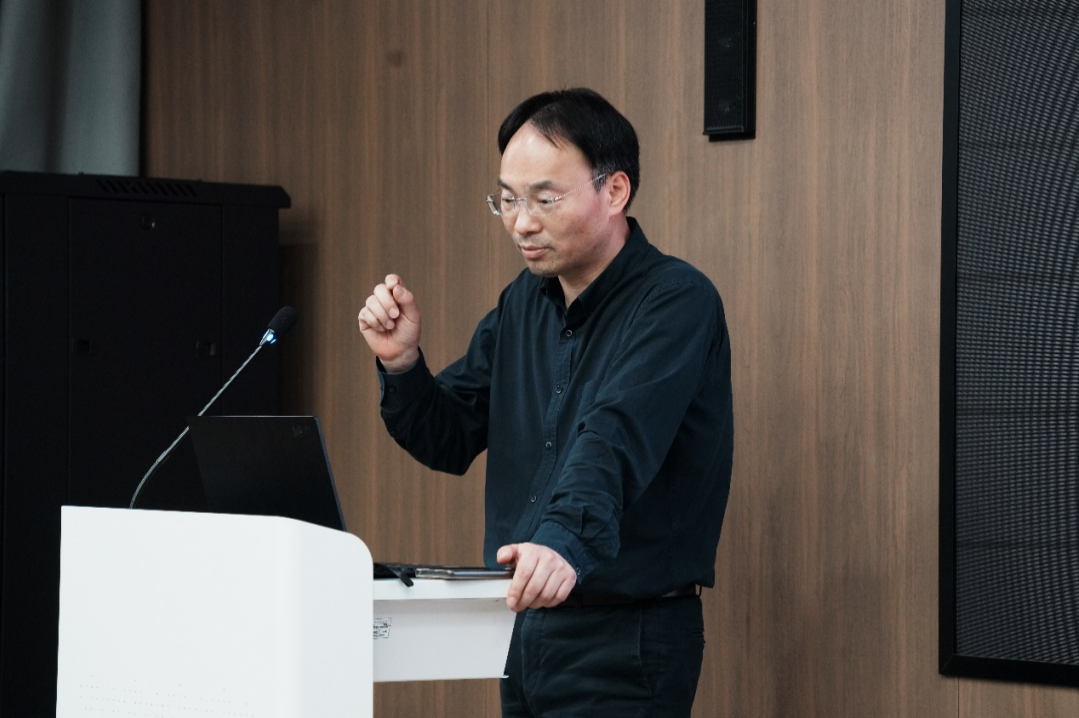
On the afternoon of May 29, Professor Qi Feng from the School of International Chinese Studies, East China Normal University delivered a lecture at the 20th Academic Forum of the School of International Education, Zhejiang University, titled “Opportunities and Challenges of International Chinese Language Education under New Circumstances.” The lecture focused on the guiding principles of the 2025 World Chinese Language Conference, the “Three Elements” of international Chinese language education, new achievements in digital and intelligent transformation, and an empirical study on generative AI (using the large language model ChatGPT as an example) in the teaching of Chinese sentence patterns. The lecture was chaired by Vice Dean Chen Weiying.
The New Circumstance: World Chinese Language Conference and Digital-Intelligence Transformation
Professor Qi Feng began by introducing the vital spirits of the 2025 World Chinese Language Conference. He pointed out that International Chinese Language Education is at a critical juncture of deep transition from traditional teaching models to digital and intelligent formats. Following this, Professor Qi provided a detailed interpretation of the “Opinions on Strengthening the Construction of Digital Chinese and Promoting the Informational Development of Language and Writing” issued jointly by three departments, including the Ministry of Education, as well as the “Reference Framework for Digital Literacy of International Chinese Language Teachers" released by the Center for Language Education and Cooperation (CLEC). He emphasized that cultivating professionals with expertise in both language education and artificial intelligence, together with enhancing teachers' digital competence, has become an urgent priority for the field.
Professor Qi also introduced a series of digital innovations unveiled at the 2025 World Chinese Language Conference, including the International Chinese Language Education Knowledge Graph, which integrates Chinese characters, vocabulary, and grammar through more than 380,000 linguistic nodes and one million semantic relationships; the International Chinese Language Education Corpus, which supports multimodal queries; “HSK GO”, an adaptive Chinese proficiency assessment platform; AI-powered cloud-based teaching and research platforms; and intelligent Chinese classrooms. Together, these achievements present a clear vision of a new digital ecosystem for international Chinese language education.
A New Paradigm: The “Three Elements” Issue and AI Empowerment
Combining the classic “Three Elements” issue (Teachers, Textbooks, and Teaching Methods) of International Chinese Language Education, Professor Qi focused on AI empowerment and digital-intelligent transformation at the teaching method level. He noted that generative large language models, represented by ChatGPT, possess unique advantages in cross-linguistic and cross-cultural understanding as well as content generation. Consequently, they can deeply participate in international Chinese classrooms across various stages—including lesson preparation and warm-ups, online interactive dialogues, post-class exercise generation, and assessment and review—thereby providing personalized feedback and situational simulations.
To verify the actual effectiveness of AI tools in teaching special Chinese sentence structures, Professor Qi shared a controlled experiment conducted by his team on ChatGPT-assisted teaching of the “ba” sentence (“把”). The research results revealed that: The traditional classroom teaching group showed a significant boost for students with weaker foundational skills in the short term; The ChatGPT teaching group, despite showing smaller short-term gains, demonstrated a superior knowledge retention rate in follow-up tests conducted one week, two weeks, and one month later. This indicates that AI's instant feedback and personalized interaction help students internalize and consolidate grammatical rules over the long term. Based on these findings, he proposed that future endeavors should explore a blended teaching model of "systematic lecture by teachers + AI-supported after-class practice" to achieve complementary advantages.
Professor Qi then demonstrated on-site the specific paths for large language models to participate in international Chinese classrooms. This included assisting teachers in generating real-life teaching contexts and multimedia materials for the “ba” sentence, conducting multi-turn sentence practice and error-correction dialogues, batch-generating objective and subjective exercises, and customizing personalized error analysis and review plans for students. He also showcased a human-AI collaborative teaching design for the “ba” sentence integrated with ChatGPT, allowing the faculty and students present to intuitively experience how digital-intelligent technology reshapes and empowers traditional classrooms.
A New Vision: Cross-Disciplinary Integration and Global Development
Toward the end of the lecture, Professor Qi expanded on a new perspective regarding the cross-disciplinary integration of Regional and Country Studies (which was officially listed in the undergraduate major catalog in 2025) and International Chinese Language Education. He also introduced Studies on Global Chinese Development, an academic journal jointly published by East China Normal University, Eötvös Loránd University in Hungary, and Aarhus University in Denmark. He called upon young scholars to focus on regional and country-specific Chinese language development, global language policies, and localized Chinese textbooks and teaching methods to serve mutual learning among civilizations and national strategies.
During the interactive session, Professor Qi engaged in warm and lively discussions with several teachers from the college's Teaching Center. Mr. Wu Jian from the Teaching Center expressed great interest in Professor Qi's controlled experiment on ChatGPT-assisted “Ba” sentence teaching. He suggested that the time factor might be an important variable in this controlled experiment, affecting the AI-assisted learning outcomes of the subjects. He added that AI agents could potentially be used to effectively collect, monitor, and organize the AI interactive learning data within such experiments. Professor Peng Lizhen from the Teaching Center concluded the lecture. Professor Peng believed that AI technology poses a challenge to traditional international Chinese teaching and research, but it also brings vast opportunities for development. How to align one's original research methods, research content, and knowledge structure with new AI technologies to elevate the level of teaching and research is an important topic that requires deep reflection.

This lecture featured a broad vision and detailed data. It helped faculty and students of the college gain deeper insights into the digital-intelligent transformation and AI-empowered teaching practices in International Chinese Language Education under the new circumstance. Furthermore, it provided valuable theoretical and practical insights for advancing the construction of our college's “Smart Chinese” intelligent learning platform, optimizing the “Chinese + Digital Intelligence” curriculum system, and upgrading teachers' digital literacy. The lecture concluded successfully amidst warm applause.
Text: Shen Yu
Photos: ICSNMC


@ Study at ZJU Wechat Subscription
Copyright © 2021International college,
Zhejiang University
Technical Support : hzccx Manage Login
You are the 1000 visitor


